Install Wednesday. Bring the models you already have. Get a pipeline that plans, builds, runs real tests, and repairs until they pass — with your approval every time.
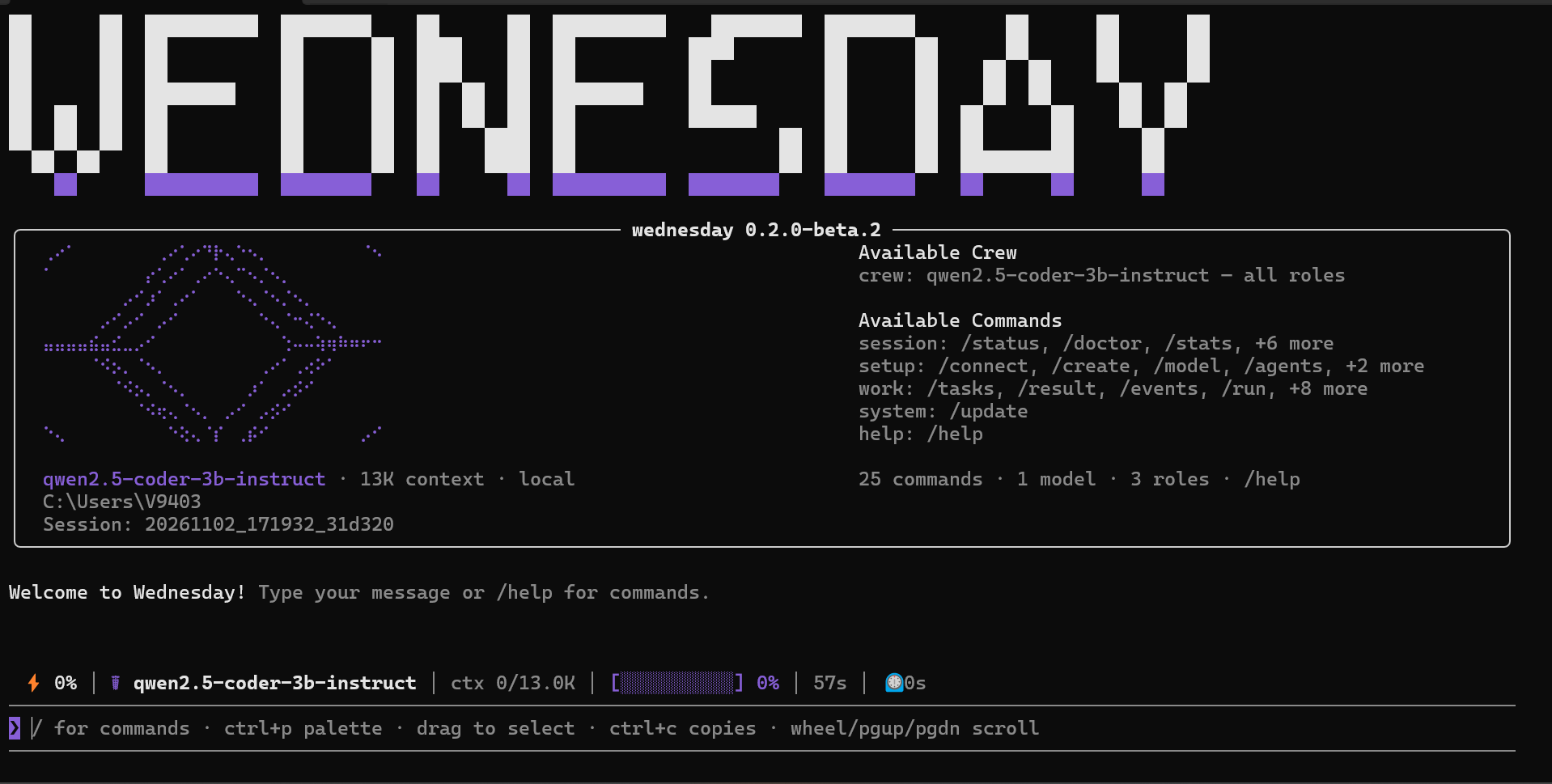
Frontier seats are metered. Small open models are free to run but produce unchecked output. The gap between “it generated something” and “it ships” is still filled by humans.
A full day on a frontier coding agent burns through daily caps before the feature is done.
No planner, no real test gate, no repair loop. Output looks plausible and fails in CI.
Regulated buyers cannot send source to frontier labs. Local models need structure to be useful.
Wednesday is the factory around the model: named roles, explicit approval, real verification, and repair until green. The tests decide — not the model’s opinion.
No plan gate. No real tests. No receipt. You still do the verification.
You approve the plan. Verification runs real commands. Failures loop until green. Receipt stays on your machine.
Keys stay on your machine. Every task requires explicit approval before any file is touched.
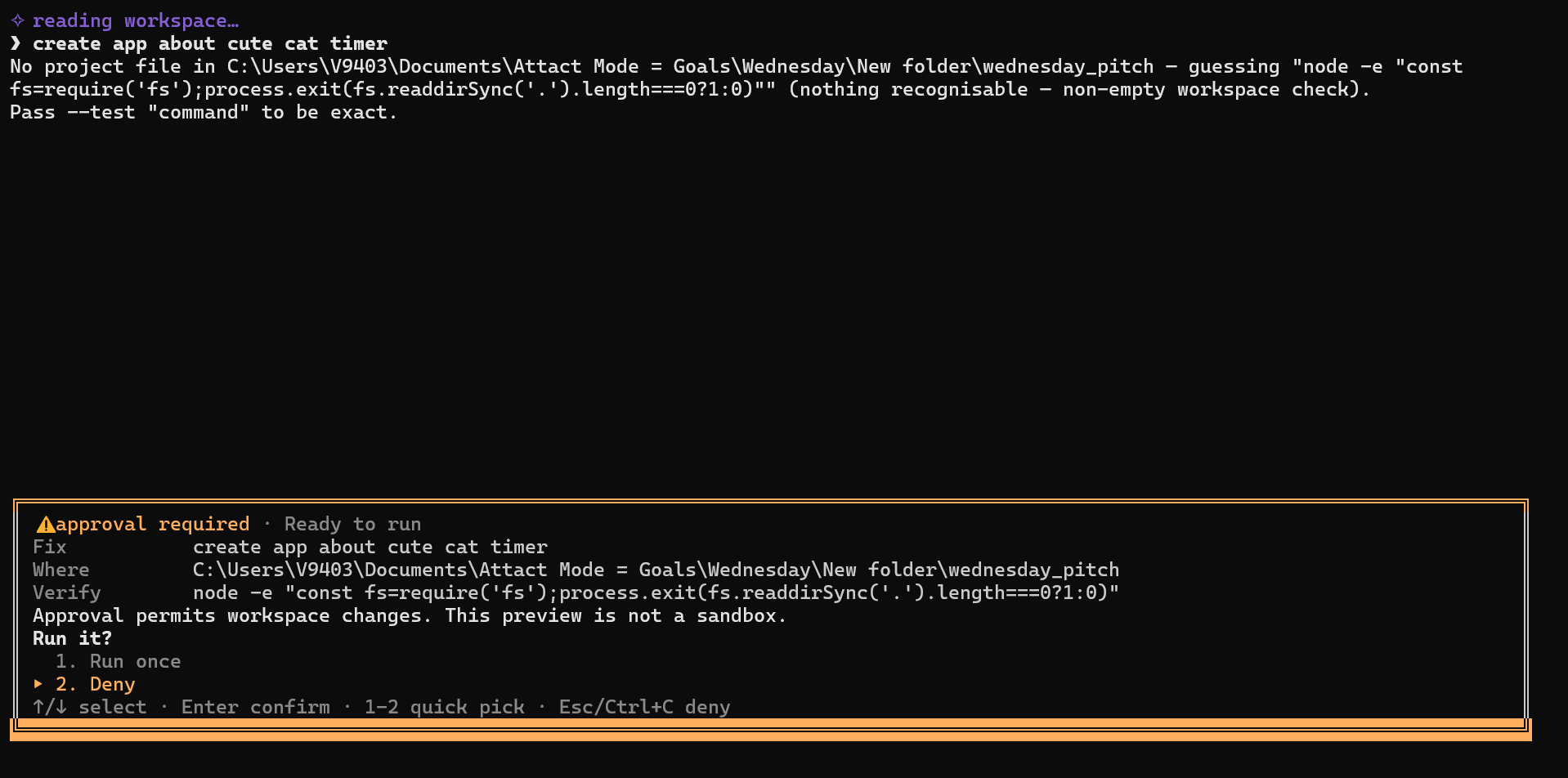
Nothing runs until you type y. Piped input never auto-approves.
Commands run against real files. The model’s opinion does not count.
Every run is persisted with evidence: tasks, events, result.
Terminal harness today. Desktop surface next. Works with any OpenAI-compatible model — local or hosted.
Command palette, pager, per-seat model picks, 21+ slash commands.
Planner, coder, vision, workers — each with its own model and repair budget.
Credentials, tasks, and event logs live in ~/.wednesday. Never leave the machine.
Three clear buyer segments that already feel the pain of metered seats and data-leaving-the-building.
Agencies and product teams already running local models who need structure so output is reliable enough to ship.
Verification loop + roles
Banks, health, defense — source cannot leave the building. Local models only work with a proper factory around them.
Air-gapped, auditable runs
Teams that hit frontier daily caps and want unlimited coding seats without another metered subscription.
Owned capacity, not tokens
Small open models crossed the usefulness threshold. The missing piece is the factory that makes them trustworthy.
The open core stays free. Revenue comes from the surfaces and services that enterprises and agencies actually need.
Terminal harness, verification loop, team roles, full source under Apache 2.0. No feature gates.
Managed runs, shared crews, usage dashboards, priority support. Billed per seat, not per token.
On-prem packaging, SSO, audit exports, dedicated support for regulated deployments.
A reliable coding seat, not a token counter
We win when customers ship more, not when they burn more tokens
Three shifts landed at the same time. Wednesday sits at their intersection.
Open 7–32B coding models now produce usable diffs. They still need a process that refuses to ship unchecked work.
Ollama, LM Studio, vLLM, and tunnels made “bring your own model” the default path for many developers.
Enterprises and regulated teams cannot keep sending source to frontier labs. They need owned pipelines.
Whoever owns the verification-first harness for open models becomes the default seat for teams that refuse another token meter.
Shipping the terminal, the verification loop, and the open-source core in public. Focused on making small models ownable and trustworthy for real teams.
We are building the structure that makes small models reliable enough to sell as seats — without token meters and without shipping source to frontier labs.
Core engineering, verification reliability, desktop surface, and first regulated pilots.
Open-source adoption → agency & GPU-host seats → enterprise air-gapped deployments.
Shipping the full open core now. No vaporware. The factory is already runnable.